
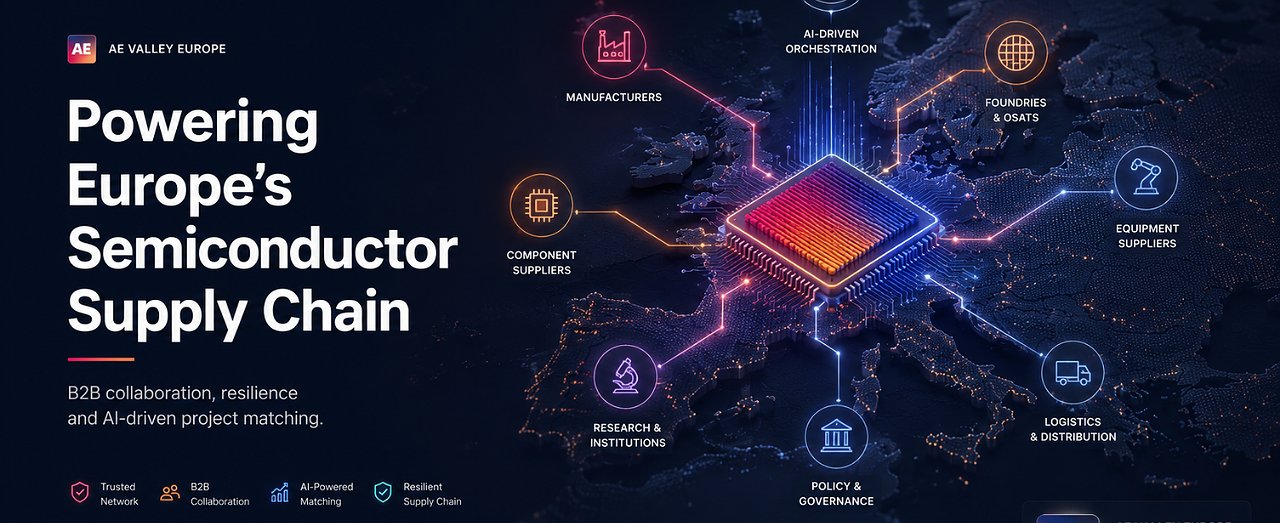
The semiconductor supply chain has become one of the clearest examples of industrial interdependence. A single chip can depend on design expertise, wafers, specialty chemicals, lithography equipment, clean room services, test capacity, packaging partners, logistics providers, software tools, certification knowledge, and public funding. Peer reviewed semiconductor supply chain research describes the field through strategic network design, coordination, simulation, demand planning, capacity planning, production planning, and fulfilment. The bottleneck is therefore rarely one company alone. It is often the ability of many specialized companies to align decisions before time, capital, and capacity are lost. ([IDEAS/RePEc][1])
AE Valley enters this coordination gap. It is not another static supplier directory and not another generic marketplace. It is a business to business project platform that turns demand into a structured execution path. The AE Valley Europe model describes three entry routes, one Diagnosis ID, verified partner recommendations, KPI gates, governance, work packages, and proof before scaling. In semiconductor terms, this means that a design company, a materials supplier, an equipment service provider, a test house, a packaging specialist, a software team, and a funding partner can move from loose interest to a governed project definition in one shared environment.
This matters because semiconductor resilience is no longer only a procurement question. Peer reviewed research on semiconductor supply chain disruption shows that recent shocks exposed structural vulnerabilities and that future resilience requires innovative supply chain management practices and decentralized networks for redundancy. For business users, the implication is direct. Resilience depends on visibility, partner readiness, risk control, and faster project formation across company boundaries. ([Taylor & Francis Online][2])
Many supply chains already have enterprise software, customer systems, procurement portals, and conference networks. What they often lack is a neutral execution layer that translates a business problem into a measurable project. AE Valley can provide that layer by combining readiness checks, use case framing, partner matching, consent based data access, KPI definition, and work package generation. For the semiconductor sector, this can support use cases such as predictive maintenance for equipment, supplier qualification, demand signal analysis, energy optimization, yield learning, process documentation, spare parts planning, and cross company quality feedback.
Digital platform research supports this logic. A peer reviewed systematic review of digital platforms for supply chain management finds that platforms change firm boundaries and create new questions around resource orchestration, make or buy decisions, and business to business supply chain tasks. In other words, a platform is not only a sales channel. It becomes an organizational mechanism for deciding what should be coordinated internally, what should be sourced externally, and how complementary capabilities can be combined. ([Emerald Publishing][3])
Research on business to business platform adoption in manufacturing also shows why AE Valley is relevant for both smaller specialists and larger industrial players. Such platforms support strategic networking, transparency, and traceability in sourcing and supplier collaboration. Small and medium sized firms tend to value flexible networks, while large firms tend to value efficiency and transaction security. AE Valley can connect both motives by making capabilities discoverable, while also turning trust into evidence through profiles, Diagnosis ID, work packages, budget logic, and verified project outcomes. ([Iris][4])
The strongest platforms do not replace relationships. They make relationships more usable. Peer reviewed research on business to business platform ecosystems describes value creation as a process involving customers, partners, and stakeholders, not as value produced by one firm in isolation. This fits the semiconductor reality. No single company can solve shortages, process complexity, supplier qualification, capacity variability, or sustainability pressure alone. A coordinated ecosystem can lower search costs, reduce friction, and improve how quickly the right partners reach a decision. ([Technical University of Munich][5])
AI gives AE Valley a role beyond matching. A SupraAgent can help translate a use case into partner suggestions, funding options, event opportunities, and work packages. A sandbox can protect productive systems while a use case is tested with pilot data. Governance rules can require that no data access happens without rights, no pilot starts without KPIs, and no scaling happens without evidence. This moves AI from demo culture into operational discipline.
The business value is clear. For semiconductor buyers, AE Valley reduces uncertainty before a project starts. For suppliers, it creates qualified visibility and a path from capability claim to verified contribution. For clusters, associations, and public programs, it creates a way to turn ecosystem intent into project evidence. For Europe, it creates a practical mechanism to connect specialized industrial competence with measurable execution.
AE Valley can become the operating layer between demand, competence, and proof. In a sector where complexity is unavoidable, the advantage will go to the networks that can decide faster, coordinate better, and verify outcomes earlier. The semiconductor supply chain does not need more noise. It needs a business to business platform where projects become visible, partners become accountable, and AI becomes operational.
[1]: https://ideas.repec.org/a/taf/tprsxx/v56y2018i13p4524-4545.html "A survey of semiconductor supply chain models part I"
[2]: https://www.tandfonline.com/doi/full/10.1080/00207543.2024.2387074 "Semiconductor supply chain resilience and disruption"
[3]: https://www.emerald.com/ijpdlm/article-pdf/54/5/449/9592628/ijpdlm-01-2023-0016.pdf "Theories of digital platforms for supply chain management"
[4]: https://iris.imtlucca.it/handle/20.500.11771/24778 "B2B digital platform adoption by SMEs and large firms"
[5]: https://portal.fis.tum.de/en/publications/value-co-creation-practices-in-business-to-business-platform-ecos/ "Value co-creation practices in business-to- ..."


